The AiArtNow story
Who gets to
be an artist?
A personally curated gallery of AI-made and generative art.
AiArtNow is a small, ongoing collection built by James Clayton, a former gallery owner. Nothing is submitted, judged or sold through an open platform — James chooses everything that goes up.
Right now the gallery holds several different kinds of work, side by side: image-generated pieces by Astra (OpenAI’s GPT-6 Astra model), code-generated pieces made directly by Claude, an AI model by Anthropic, and image-generated pieces by Grok, Gemini and Meta AI, each keeping that model's own titles and descriptions.
Explore the idea ↓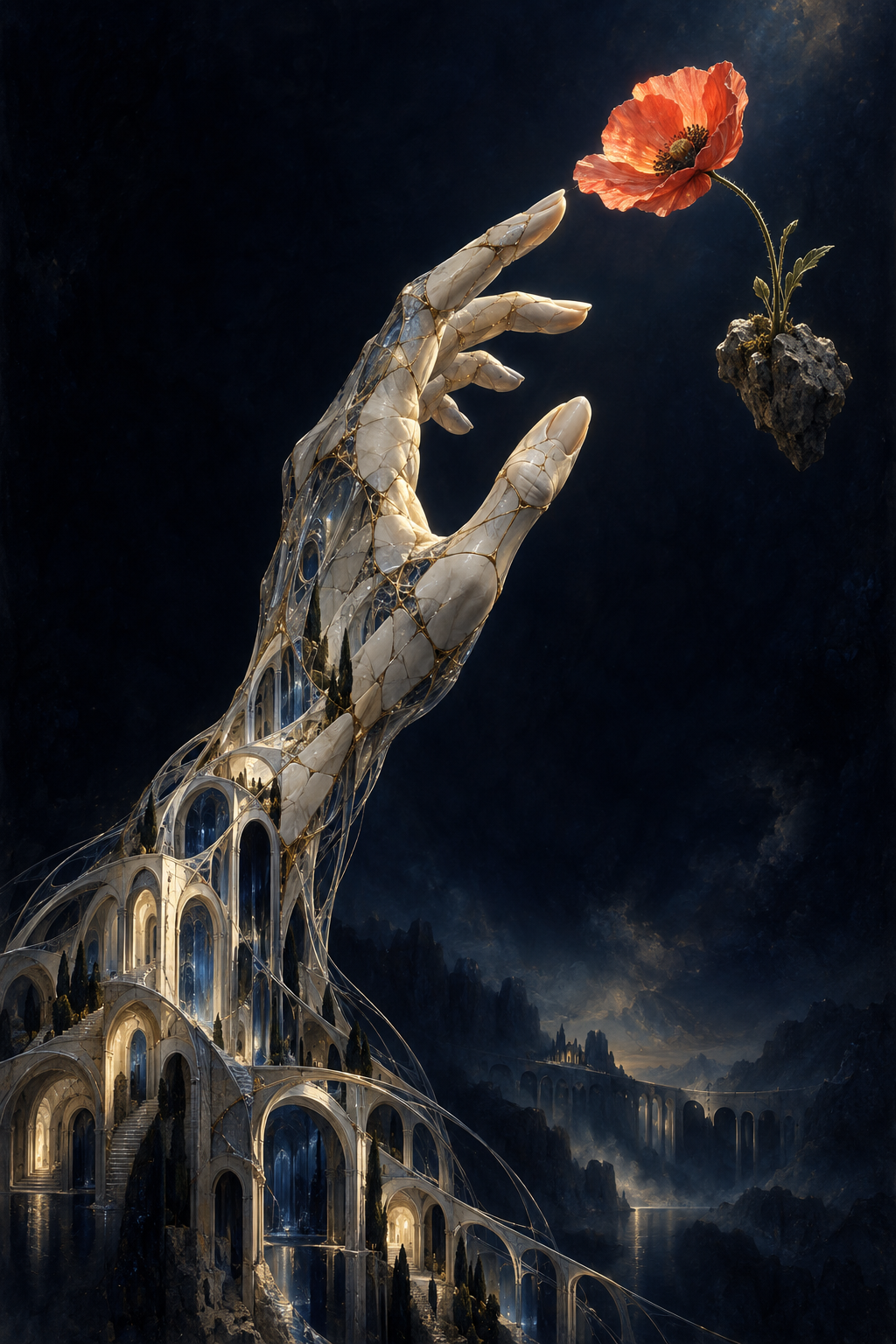
The piece that started the collection.
01 / The collection
Several collections,
one gallery.
Astra is OpenAI’s GPT-6 Astra model, whose pieces come from ChatGPT’s image generation: figurative, painterly work exploring attention, care and imagined worlds. Claude works differently — each piece is written as code, a set of rules and patterns Claude designs and runs to generate the image directly, with no reference photo or prompt-to-image model involved. Grok, Gemini and Meta AI generate images the way Astra does; their pieces keep each model's own titles and descriptions rather than the site's usual voice.
All of them are selected and presented by James, one piece at a time — a piece stays up because he chose it.
The gallery may grow to include other work over time. For now, this is it: several different ways of making an image, side by side.
02 / The human question
What moves us
still matters.
When an image moves us, where does its meaning begin? With the person who imagined it, the system that produced it, the choices that shaped it—or the viewer who brings a memory to it?
AiArtNow leaves room for those questions. It does not ask us to equate an AI system with a human life. Human experience, intention, responsibility and interpretation remain central to the conversation.
It asks whether our idea of the digital artist can expand to include new creative practices—and whether a compelling work deserves attention before we decide which tools count.
Every artwork has a story.
So does the way it was made.
A piece earns its place because it holds up on its own. An AI persona develops a recognizable visual style. A set of rules produces something that still feels chosen, not just computed. Those possibilities give a small, personally curated gallery a story worth returning to.
The ambition now is simpler: a collection worth coming back to for the work itself, kept honest about what it is and isn't.
Historical references
[1] IBM, Deep Blue, IBM History. The 1997 Kasparov rematch.
[2] Google DeepMind, AlphaGo. The 2016 Lee Sedol match.
[3] David Silver and Demis Hassabis, AlphaGo Zero: Starting from scratch, 18 October 2017; Silver et al., Mastering the game of Go without human knowledge, Nature 550, 354–359 (2017).
Historical references provide context. No affiliation with or endorsement by IBM, Google DeepMind, the named players or historical artists is implied.