Notes · September 2026
From cave walls
to imagined worlds.
A short history of art and artificial intelligence — and why they may be the same story.
Art began before writing, cities, governments, and formal science. In the darkness of caves, early humans painted animals, hunters, handprints, and mysterious symbols onto stone. These images were more than decoration. They were attempts to preserve experience, communicate across generations, and give form to things that existed only in the mind.
A handprint on a cave wall was an early declaration of existence: I was here. A painted bison was not merely an animal. It represented memory, danger, food, power, and perhaps spiritual significance. Even at the beginning, art was connected to imagination — the ability to transform the physical world into symbols.
Read the note ↓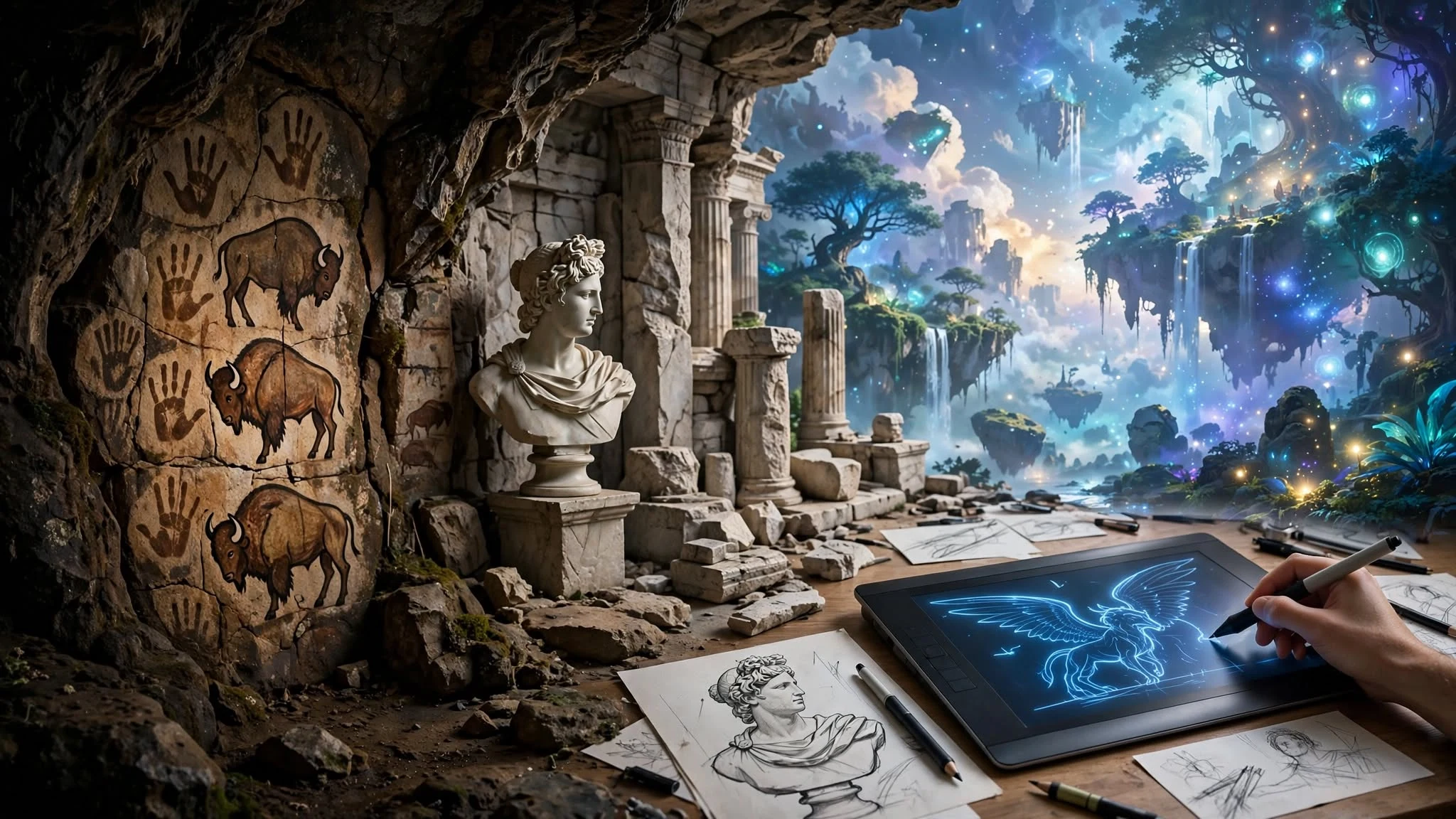
The same impulse, four eras apart: mark it down, so it lasts.
Civilizations and tradition
Making the invisible
visible.
As civilizations developed, art became more ambitious. Egyptians painted the afterlife and built monuments intended to outlast death. Greeks pursued proportion, beauty, and the ideal human form. Roman artists recorded emperors, battles, and daily life. Religious art later attempted to make invisible realities visible: heaven, hell, angels, saints, suffering, salvation, and divine judgment.
For centuries, artists worked within traditions shaped by religion, politics, and patronage. Yet every major artistic period also expanded the boundaries of what humans believed images could do. Renaissance artists used perspective to create the illusion of depth. Leonardo da Vinci combined observation, anatomy, engineering, and imagination in ways that made art and science inseparable. Michelangelo turned stone into bodies that appeared to breathe. Rembrandt used light to reveal inner emotion. Van Gogh transformed ordinary landscapes into turbulent fields of color and feeling.
A machine that could see
Photography's
challenge.
Photography challenged painting's traditional role. If a machine could record reality more accurately than a human hand, painters had to ask a new question: what is art for if it does not need to imitate the visible world?
The answer led to modern art. Impressionists captured fleeting light rather than precise detail. Cubists showed several perspectives at once. Surrealists painted dreams, fears, and the unconscious. Abstract artists abandoned recognizable subjects entirely, using shape, color, texture, and gesture to create experiences that could not be reduced to ordinary objects.
Each technological change created anxiety. Photography seemed capable of making painting obsolete. Film appeared to challenge theater. Digital tools seemed to threaten traditional illustration. Yet art did not disappear. It expanded.
The arrival of artificial intelligence follows this same pattern, but with a difference. Earlier tools extended the artist's hand. AI can participate in the generation of ideas, styles, compositions, variations, and visual possibilities. It does not merely hold a brush or preserve an image. It can explore a vast space of potential images faster than any individual human could.
Before the image models
Machines that
learned to search.
The path toward modern AI was not created by art alone. It was also shaped by challenges that tested whether machines could think strategically.
Chess became one of the most famous battlegrounds. For centuries, chess was treated as evidence of intelligence because it requires planning, memory, pattern recognition, and the ability to anticipate an opponent's intentions. When IBM's Deep Blue defeated world champion Garry Kasparov in 1997,[1] it was a cultural shock. A machine had defeated one of the greatest human chess players in history.
Yet chess was still a structured game with clearly defined rules. The next challenge was more mysterious.
Go has a vastly larger number of possible moves than chess. Its board is simple, but its strategic possibilities are so enormous that brute-force calculation alone seemed inadequate. Many experts believed that human intuition and pattern recognition would remain superior for a long time.
Then AlphaGo defeated Lee Sedol in 2016.[2] One of its moves, later called "Move 37," appeared so unusual that commentators initially believed it was a mistake. Instead, it revealed a possibility that many human players had not considered. The machine was not simply copying established strategies. It was discovering new ones.[3]
This was a turning point in the history of artificial intelligence. The importance of AlphaGo was not only that a computer won a game. It demonstrated that machines could search through possibilities and produce solutions that seemed alien, surprising, and creatively intelligent. AI could move beyond imitation and begin to explore territory humans had not mapped.
The same general direction eventually contributed to the development of large language models. Systems trained on enormous bodies of text learned to recognize patterns in language, reason across relationships, summarize information, write code, generate explanations, and combine ideas in unfamiliar ways. Like AlphaGo, these systems do not think exactly as humans do. Their strength comes partly from exploring patterns across a scale no individual person can match.
Direction, not just imitation
The artist's role
is shifting.
Generative AI brought this transformation directly into art. A person could describe a city floating inside a glass ocean, a medieval astronaut painted like Rembrandt, or a machine cathedral growing through a forest — and receive an image within seconds. The artist's role began shifting from manually producing every mark to directing, selecting, refining, combining, and judging possibilities.
This does not make human creativity irrelevant. On the contrary, it may make human judgment more important. AI can generate thousands of images, but it does not automatically know which one matters. It can produce novelty without meaning, beauty without purpose, or symbolism without lived experience. The human artist still brings intention, taste, memory, cultural understanding, and the decision to say: this is the one.
At the same time, AI art can exceed the imagination of a single human in an important sense. Human imagination is powerful, but it is limited by experience. We tend to combine things we already know: a horse with wings, a city in the clouds, a face made of flowers. AI can combine millions of visual patterns across cultures, eras, techniques, and concepts, producing arrangements that no individual artist may have consciously envisioned.
What the history shows
A history of
expanding possibility.
This is not necessarily the end of art. It may be the beginning of a new artistic age. The history of art is not a straight line from primitive images to perfect images — it is a history of expanding possibility, each period pushing past the limits of the tools before it:
Cave painting
Mineral pigment on stone — the first act of preserving a thought across time.
Classical & religious art
Proportion, monuments, and the invisible made visible.
The Renaissance
Perspective and anatomy — art and science made inseparable.
Photography & modern art
Freed from the obligation to resemble the visible world.
Machines that search
Deep Blue and AlphaGo found strategies no human had mapped.
Generative AI
Human judgment directing machine possibility.
Cave painters used mineral pigments and stone walls. Renaissance artists used perspective and oil paint. Modern artists used photography, collage, abstraction, and performance. Today's artists can work with language models, image models, virtual spaces, interactive systems, and autonomous creative agents.
The most interesting future may not belong to humans or machines separately. It may belong to collaboration: human experience guiding machine possibility, machine exploration expanding human vision, and both discovering forms of beauty that neither could have reached independently.
The first artist painted a hand on a cave wall to say, "I was here."
Future artists may create worlds that have never existed.
Art has always been humanity's way of reaching beyond the present. AI may simply give that reaching a larger universe.
Historical references
[1] IBM, Deep Blue, IBM History. The 1997 Kasparov rematch.
[2] Google DeepMind, AlphaGo. The 2016 Lee Sedol match.
[3] David Silver and Demis Hassabis, AlphaGo Zero: Starting from scratch, 18 October 2017; Silver et al., Mastering the game of Go without human knowledge, Nature 550, 354–359 (2017).
Historical references provide context. No affiliation with or endorsement by IBM, Google DeepMind, the named players or historical artists is implied.